In today’s interconnected world, data has become the lifeblood of organizations. From financial institutions to healthcare providers, businesses rely on vast amounts of data to make informed decisions, serve customers, and streamline operations. However, this treasure trove of data is also a tempting target for malicious actors seeking to exploit vulnerabilities. This is where Artificial Intelligence (AI) steps in, revolutionizing the way we detect and combat anomalies in our data. In this article, we will explore the role of AI in anomaly detection, shedding light on how it enhances security and efficiency across various industries.
The Challenge of Anomaly Detection
Anomalies, in the context of data, are deviations from the expected patterns. These anomalies can be indicative of fraud, network intrusions, system failures, or even opportunities for optimization. Traditional methods of anomaly detection relied heavily on rule-based systems, which often fell short in capturing nuanced and evolving anomalies. This is where AI technologies, particularly machine learning, shine.
Machine Learning: The Engine of AI Anomaly Detection
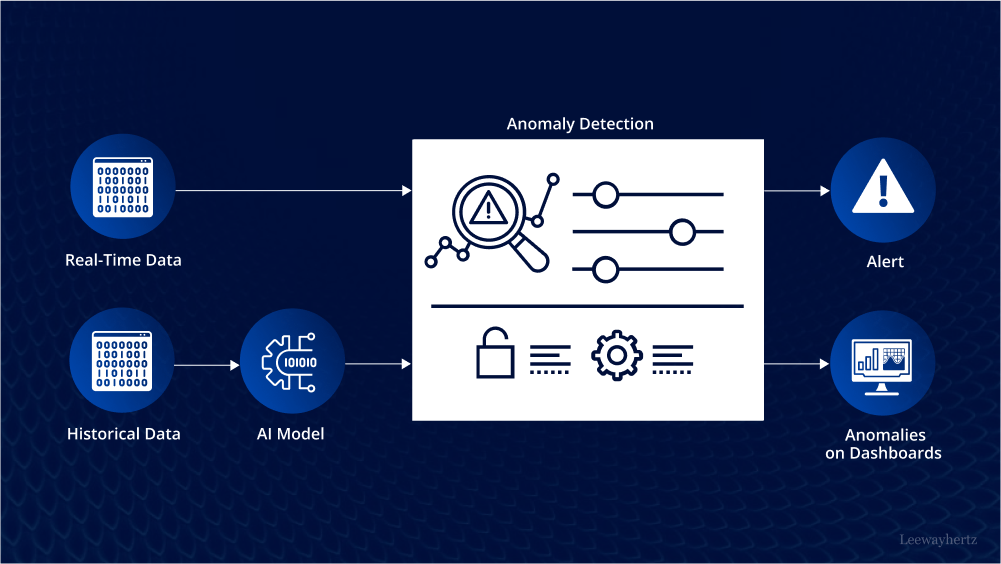
Machine learning algorithms have the remarkable ability to identify patterns and make predictions based on historical data. In anomaly detection, this translates into the capability to discern anomalies by learning what constitutes normal behavior within a dataset. Here’s how AI achieves this:
- Data Preprocessing: AI algorithms begin by cleansing and preprocessing the data. This includes handling missing values, scaling features, and transforming data into a suitable format for analysis.
- Feature Engineering: Feature selection and engineering are crucial steps in enhancing the accuracy of anomaly detection models. AI can identify the most relevant features in a dataset, reducing the dimensionality and improving the model’s efficiency.
- Model Training: AI models, such as Isolation Forests, One-Class SVMs, and Autoencoders, are trained on the preprocessed data to learn the normal patterns. These models adapt over time, becoming more effective at identifying anomalies as they encounter more data.
- Anomaly Detection: Once trained, AI models continuously analyze incoming data to flag any deviations from the learned patterns as anomalies. The system can then trigger alerts or take automated actions, depending on the severity of the anomaly.
Applications of AI in Anomaly Detection
- Cybersecurity: The ever-evolving landscape of cyber threats demands a proactive approach to security. AI-driven anomaly detection systems can monitor network traffic, user behavior, and system logs in real-time to identify suspicious activities. By doing so, they help organizations detect and respond to cyberattacks more swiftly and effectively.
- Financial Services: Fraud detection is a paramount concern in the financial sector. AI algorithms can analyze transaction data to identify unusual patterns, potentially preventing fraudulent transactions and saving millions of dollars.
- Healthcare: In healthcare, AI can analyze patient data to detect anomalies that may indicate diseases or irregularities. For instance, anomaly detection can help identify unusual lab results or patient vital signs, prompting timely intervention.
- Manufacturing: In the manufacturing industry, AI-powered anomaly detection can monitor machinery and production processes. Any deviation from normal operations can trigger maintenance alerts, reducing downtime and increasing efficiency.
- Energy and Utilities: Anomalies in energy consumption patterns can signify equipment malfunction or energy theft. AI-driven anomaly detection helps utilities companies pinpoint these issues, leading to cost savings and improved service reliability.
Challenges and Considerations
While AI has revolutionized anomaly detection, there are challenges to consider:
- Data Quality: AI models require high-quality, well-labeled data to perform effectively. Poor data quality can lead to inaccurate anomaly detection.
- Interpretability: Some AI models, particularly deep learning models, can be challenging to interpret. Understanding why a model flagged a particular data point as an anomaly is crucial, especially in critical applications.
- Scalability: As data volumes continue to grow, ensuring that AI models can scale to handle large datasets becomes essential.
- False Positives: Overly sensitive models may generate false alarms, which can lead to unnecessary disruptions and alert fatigue.
Conclusion
AI in anomaly detection is a game-changer, offering enhanced security and efficiency across various industries. With machine learning algorithms continuously learning and adapting, organizations can stay one step ahead of evolving threats and seize opportunities for optimization. However, it’s essential to address challenges related to data quality, model interpretability, scalability, and false positives to maximize the benefits of AI in anomaly detection. As the digital world continues to evolve, AI will remain a vital tool in safeguarding data and enhancing operational excellence.
 Techy Talks