In the ever-evolving landscape of healthcare, technological advancements have consistently played a pivotal role in enhancing patient care and outcomes. One such breakthrough is the integration of Generative Artificial Intelligence (AI) in healthcare, which has begun to reshape the industry. This revolutionary technology is poised to revolutionize diagnosis and treatment by harnessing the power of data-driven creativity and automation. In this article, we will explore how Generative AI in healthcare is transforming the way we approach medical challenges and improve patient well-being.
Understanding Generative AI in Healthcare
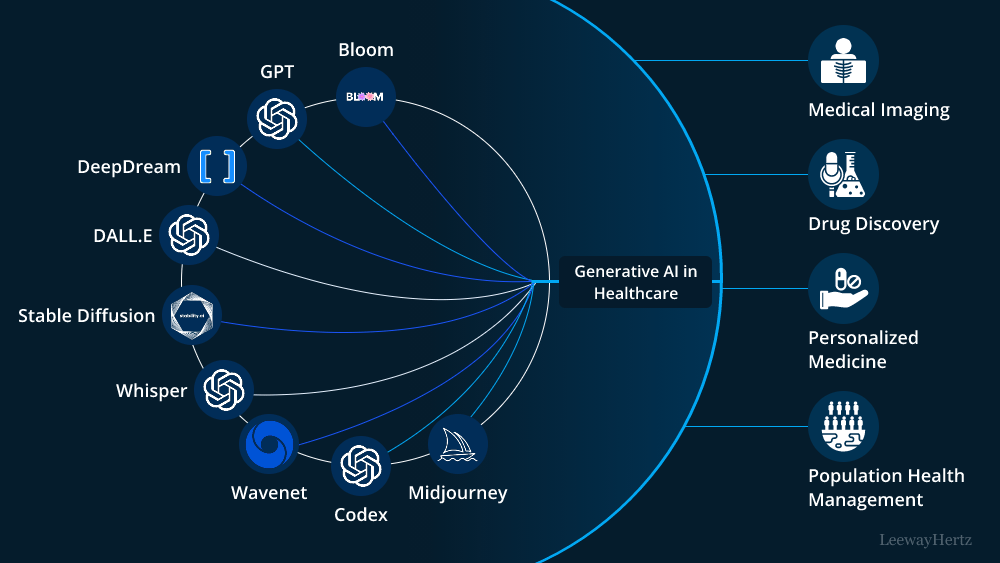
Generative AI, a subset of artificial intelligence, focuses on creating data or content rather than just processing and analyzing it. This technology employs neural networks to generate new, original content based on patterns it has learned from existing data. In the context of healthcare, Generative AI uses vast datasets of medical records, imaging, and patient information to assist healthcare professionals in various aspects of their work.
Disease Diagnosis and Predictive Analytics
One of the most significant impacts of Generative AI in healthcare is in the realm of disease diagnosis and predictive analytics. Traditional diagnostic processes often rely on manual examination and interpretation of medical images, such as X-rays and MRIs. Generative AI algorithms can analyze these images with incredible speed and accuracy, helping clinicians detect abnormalities and potential health issues more effectively.
For instance, Generative AI models can be trained to identify anomalies in medical images, such as tumors, fractures, or organ damage, with a higher level of precision than human experts. This not only reduces the chances of misdiagnosis but also accelerates the diagnostic process, allowing for faster treatment initiation and better patient outcomes.
Moreover, Generative AI excels in predictive analytics. By analyzing historical patient data, it can predict disease onset, progression, and treatment response. This capability enables healthcare providers to personalize treatment plans and interventions, ultimately improving patient care.
Drug Discovery and Development
The pharmaceutical industry has been greatly impacted by Generative AI in healthcare. Drug discovery and development are traditionally laborious, time-consuming, and expensive processes. However, Generative AI can streamline these processes by analyzing vast datasets of molecular structures, pharmacological data, and clinical trial results.
Generative AI models can generate novel drug candidates with specific properties and potential therapeutic effects. This innovation expedites drug discovery, reduces costs, and increases the likelihood of finding new treatments for various diseases, including rare and complex conditions.
Natural Language Processing in Healthcare
Another area where Generative AI shines is natural language processing (NLP). NLP algorithms can analyze and interpret medical texts, including patient records, research papers, and clinical notes. This technology aids healthcare professionals in extracting valuable insights from a massive amount of textual data.
Generative AI can be used to automate medical coding and transcription, reducing administrative burdens and minimizing errors. It can also assist in clinical decision support by summarizing relevant research articles and patient histories, helping clinicians make informed decisions more efficiently.
Enhancing Telemedicine and Remote Monitoring
The COVID-19 pandemic accelerated the adoption of telemedicine and remote patient monitoring. Generative AI plays a crucial role in enhancing these services by providing virtual assistants and chatbots that can engage with patients, answer their questions, and collect health-related information. These AI-driven interactions improve patient engagement and streamline the remote care process.
Additionally, Generative AI can analyze real-time data from wearable devices and sensors, providing continuous monitoring of patients’ vital signs and health metrics. This proactive approach enables early detection of health issues, reducing hospital admissions and emergency room visits.
Ethical Considerations and Privacy Concerns
While Generative AI holds immense promise in healthcare, it also raises ethical considerations and privacy concerns. Protecting patient data and ensuring that AI algorithms are fair and unbiased are critical challenges that must be addressed. Healthcare organizations must implement robust data security measures and adhere to strict ethical guidelines when employing Generative AI technologies.
Conclusion
Generative AI in healthcare is a game-changer that promises to revolutionize diagnosis and treatment. By leveraging the power of data-driven creativity and automation, this technology is enhancing disease diagnosis, drug discovery, patient engagement, and remote monitoring. However, it also comes with ethical and privacy challenges that demand careful consideration. As Generative AI continues to advance, it holds the potential to reshape the healthcare industry, making it more efficient, personalized, and ultimately, more effective in improving patient well-being.
 Techy Talks