In today’s fast-paced financial landscape, Private Equity (PE) firms are constantly seeking ways to gain a competitive edge. One of the most promising avenues they have explored in recent years is the integration of Artificial Intelligence (AI) into their investment strategies. AI in private equity has revolutionized how firms identify opportunities, manage risk, and optimize their portfolios. In this article, we will delve into the ways AI is reshaping the private equity industry.
1. Data-Driven Decision Making
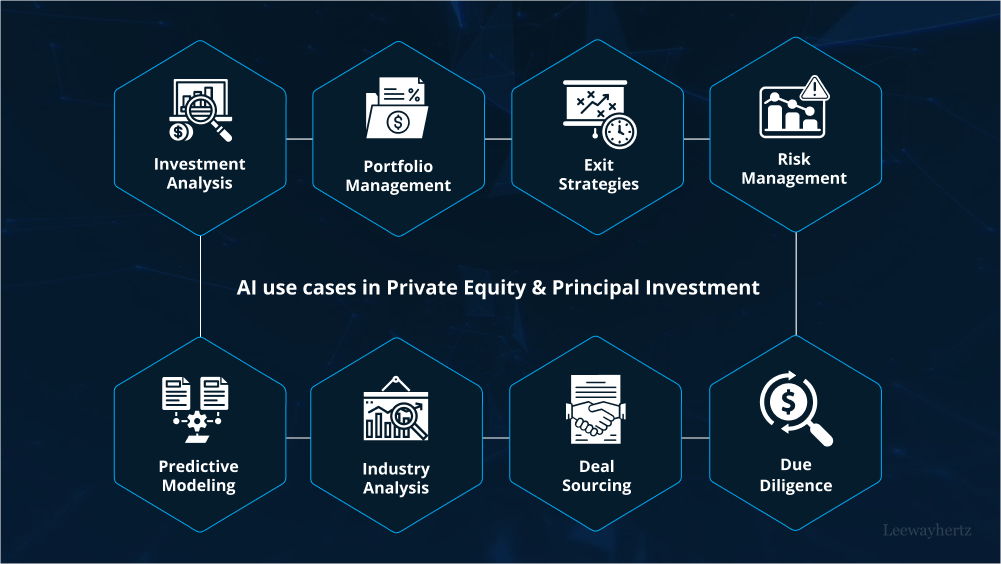
At the core of AI’s impact on private equity is its ability to analyze vast amounts of data with unprecedented speed and precision. Private equity firms traditionally relied on manual analysis and intuition, but AI has shifted the paradigm. Machine learning algorithms can process financial statements, market trends, and economic indicators at a scale impossible for humans to match. This data-driven approach enables PE firms to make more informed investment decisions and identify hidden opportunities.
2. Enhanced Due Diligence
Due diligence is a critical phase in any private equity investment. It involves assessing a target company’s financial health, operational efficiency, and growth potential. AI tools can streamline this process by automatically collecting and analyzing relevant data from various sources. Natural language processing (NLP) algorithms can even extract insights from unstructured data, such as news articles and social media, to assess a company’s reputation and market sentiment.
3. Predictive Analytics
AI’s predictive capabilities are a game-changer for private equity. Machine learning models can forecast future financial performance and market trends with remarkable accuracy. This allows PE firms to proactively adjust their investment strategies, allocate resources more effectively, and minimize risk. Predictive analytics can also help in evaluating exit strategies and timing, ultimately maximizing returns for investors.
4. Portfolio Optimization
AI can significantly enhance portfolio management by continuously monitoring and optimizing asset allocation. Algorithms can rebalance portfolios in real-time based on changing market conditions, ensuring that investments are aligned with the firm’s risk tolerance and return objectives. This dynamic approach reduces the impact of market volatility and enhances overall portfolio performance.
5. Risk Management
Private equity investments inherently carry risk, but AI can help mitigate it. Machine learning models can identify early warning signs of potential issues within portfolio companies, enabling PE firms to take proactive measures to address challenges before they escalate. Additionally, AI can assist in stress testing portfolios to assess their resilience under various economic scenarios.
6. Deal Sourcing and Screening
AI-driven tools can automate the process of deal sourcing and screening. By analyzing historical data, market trends, and investor preferences, AI can identify potential investment opportunities that align with a PE firm’s investment thesis. This not only saves time but also enhances the likelihood of discovering hidden gems in a crowded market.
7. Valuation
Determining the fair value of a target company is crucial in private equity transactions. AI can assist in this process by analyzing historical financial data, market comparables, and other relevant factors to provide a more accurate valuation. This ensures that PE firms enter negotiations with a clear understanding of a company’s worth.
8. Regulatory Compliance
The private equity industry is subject to an evolving regulatory landscape. AI can help PE firms stay compliant by automating the monitoring of regulatory changes and ensuring that their investment strategies adhere to current laws and regulations. This reduces the risk of costly legal issues and reputational damage.
Challenges and Considerations
While AI offers immense potential in private equity, there are challenges to consider. Data privacy and security are paramount concerns, as PE firms handle sensitive financial information. Additionally, there is a learning curve associated with implementing AI, and firms must invest in talent and technology to fully harness its capabilities.
Conclusion
AI is ushering in a new era of innovation and efficiency in private equity. Firms that embrace AI technologies stand to gain a competitive advantage by making data-driven decisions, improving due diligence processes, optimizing portfolios, managing risks more effectively, and identifying lucrative investment opportunities. As the private equity landscape continues to evolve, AI will remain a powerful tool for those looking to thrive in this dynamic industry. It’s not just a buzzword; it’s a transformational force shaping the future of private equity.
 Techy Talks